
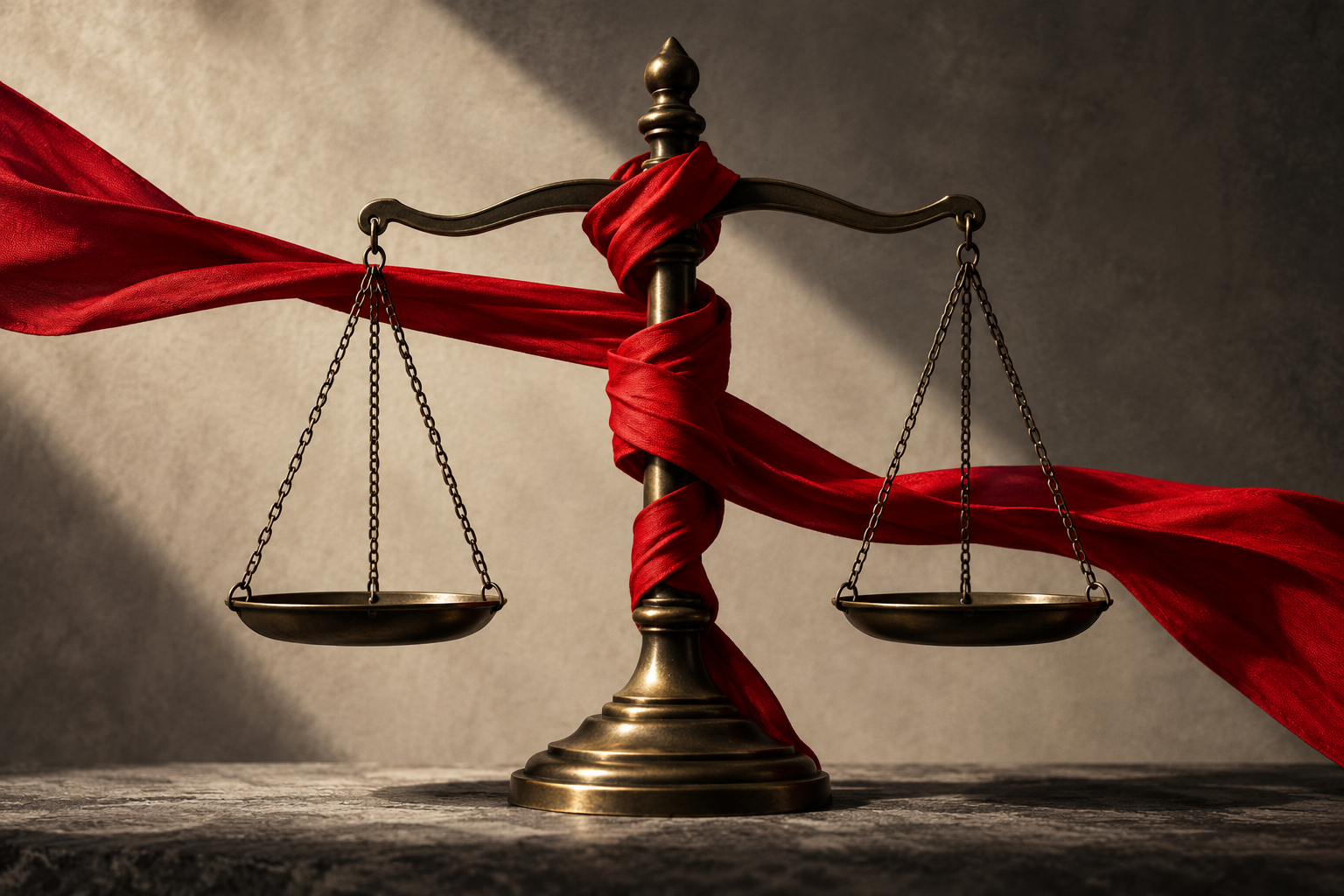
Institutional betrayal and the burden placed on survivors seeking justice
You have been hit. You have been touched inappropriately. You have been violated.
Shame, despair, rage follow, along with a feeling of profound helplessness. Deep down, you want to stand up, to fight for justice, but the stigma of society demands your silence.
You turn to friends, to family, hoping for refuge and understanding. But instead, their own discomfort when confronted with subjects considered taboo may demand your silence and your shame. At other times, victims do not dare to speak up for fear of retaliation. The abuser may hold more power, supported by family, friends and institutional allies.
What happens all too often is that your voice is sacrificed for silence. And silence allows this cycle of violence to continue.
Some survivors muster the courage to speak up against violence. File a complaint. Show up hearing after hearing. Trust the process, no matter how many delays and counter-allegations are thrown at them.
But what happens when a complaint is met with indifference? When someone is sent from one office to another without a clear answer? When another hearing is postponed and the person waiting has to find the money and strength to return?
For a survivor, reaching out can mean placing their safety in someone else's hands. The response they receive matters. It can offer a way forward or leave them feeling more exposed than before.
In today's world, speaking up comes at a cost. Therefore, many choose to remain silent, for fear of retaliation from the abuser and/or the institution.
When an institution fails the person who needs it
There is a name for the harm caused when an institution betrays the trust of someone who depends on it: institutional betrayal. Research by Carly P. Smith and Jennifer J. Freyd examines how institutions can cause harm through their actions and through failures to prevent or respond adequately to abuse.
This can happen in a workplace, a university, a police station and other systems responsible for protection and justice.
Sometimes the failure is visible: a report is dismissed or the person reporting is treated with hostility. Sometimes it is harder to identify. Nobody explains the next step. Calls go unanswered. Responsibility passes between departments until the survivor has no idea who is accountable.
A person may have done everything they were asked to do and still be left without help.
We need to recognise what that means. Someone has disclosed something painful, perhaps at considerable personal risk. They have approached an institution because they need something they cannot provide for themselves. When that institution fails them, the consequences extend beyond an unfinished file.
There is also something deeply dehumanising about a process in which a person's experience is reduced to a statement, a case number or a piece of evidence. The survivor becomes someone to be questioned, assessed and processed, rather than a person whose dignity and safety deserve consideration.
When the same experience must be recounted repeatedly, often to strangers and without any certainty that it will lead somewhere, the process itself can become another source of distress.
When institutions choose to protect themselves
Institutions exist to protect and safe-guard society and especially the vulnerable. When they fail to do this, what safety or protection does a survivor have?
Institutional betrayal can happen with the police, the courts, it can happen in universities, hotels, workplaces and other spaces.
Consider a university where a student reports a bias, assault, discrimination or sexual harassment involving someone with influence or standing within the institution. Instead of ensuring an impartial investigation, the administration may discourage the complaint, question the student's credibility or prioritise the institution's reputation. The person who came forward seeking protection may find themselves facing disciplinary threats, academic pressure or counter-allegations.
Hotels and hospitality establishments can present similar concerns. When an incident of harassment or violence is reported on their premises, management has a responsibility to respond appropriately, preserve relevant evidence and cooperate with lawful investigations. Yet an institution concerned primarily with protecting its reputation may choose silence, dismiss complaints or fail to preserve crucial records, including CCTV footage.
Particularly troubling is the use of retaliatory counter-allegations. A person reporting abuse may suddenly find themselves accused of misconduct, harassment or other wrongdoing. Where such allegations are deliberately fabricated to discredit or intimidate a complainant, they become another means of exercising power.
There is a danger that these responses become normalised. The original complaint is pushed aside, attention shifts to the credibility or conduct of the person who reported it, and the institution presents its inaction as neutrality.
Of course, every allegation, including a counter-allegation, must be assessed fairly and on its evidence. But procedural fairness must not become a convenient justification for ignoring intimidation, retaliation or an institution's responsibility to investigate.
Whether the setting is a university campus, a hotel corridor or a police station, the underlying question remains the same: when someone reports violence, whose interests does the institution choose to protect?
Calling police corruption by its name
We also need to speak plainly about police corruption. When an officer deliberately suppresses evidence, intimidates a witness or uses their position to shield the accused from investigation, the harm comes from an abuse of entrusted power.
The conduct that demands scrutiny includes:
Tampering with evidence: altering, fabricating, concealing or destroying material that could help establish what happened.
Manipulating official records: deliberately misrecording a complaint or witness statement, omitting relevant information or creating a false account.
Witness intimidation: threatening survivors, witnesses or their families, pressuring them to change their accounts or withdraw complaints, or knowingly helping others do so.
Interference with digital evidence: deleting or altering messages, recordings, photographs or other relevant files. Allegations of hacking phones or accounts to access or destroy evidence also require independent forensic investigation.
Bribery and collusion: demanding payment for official action or accepting money or favours to suppress a complaint, obstruct an investigation or protect an accused person.
In Mahender Chawla v. Union of India, decided on 5 December 2018, the Supreme Court discussed intimidation and manipulation of witnesses, alongside earlier judgments highlighting incorrect recording of statements by police. It approved the Witness Protection Scheme, 2018 and directed its enforcement.
The responsibility to protect a witness becomes especially urgent when the allegation concerns an officer within the institution meant to provide that protection. There must be a credible way to report misconduct and have it examined beyond the control of those implicated.
Digital evidence needs the same seriousness. If a recording disappears or messages are deleted, the investigation must establish what happened, who had access and whether the loss was deliberate. A missing file alone does not establish hacking or identify who was responsible. But suspected interference should be examined promptly, with the remaining records preserved.
For a survivor, these concerns add another burden: having to protect the evidence of the violence while asking the authorities to investigate it.
Where misconduct is established, accountability must reach the officers responsible and anyone who knowingly enabled it. But how does that happen when the very system responsible for investigating wrongdoing may be compromised?
When political influence enters the process
The question becomes even more difficult when political influence or powerful personal connections are involved.
The possibility that someone with influence may be able to pressure officials, interfere with an investigation or discourage a complaint raises serious questions about whether everyone has equal access to justice.
Such interference can take different forms. An investigation may be delayed or redirected. Witnesses may face pressure. A complainant may be subjected to threats, public attacks on their credibility or retaliatory allegations intended to discourage them from continuing.
False or fabricated allegations, when deliberately used as instruments of intimidation, can inflict further damage on a person's reputation, safety and dignity. They can force someone already seeking protection into the position of having to defend themselves against an entirely different accusation.
This is why independent scrutiny matters. Justice cannot depend on who someone knows, what position they occupy or how much influence they can exercise over the people responsible for investigating a complaint.
For a survivor who believes that the person they have accused enjoys political or institutional protection, the fear may extend well beyond the original violence. They may begin to question whether the system can protect them at all.
The work that falls on the survivor
Seeking justice can become a second job.
There are documents to organise, appointments to attend and conversations to repeat. There may be travel costs, legal fees and time away from paid work. Someone has to arrange childcare. Someone has to follow up when an answer does not come.
That someone is often the person already living with the consequences of the violence.
The burden on the body, the nervous system and the mind is often overlooked. The constant anticipation of another hearing, another question or another confrontation can make it difficult to return to ordinary life.
From outside, a postponed hearing may look like a change in the calendar. For the person waiting, it may mean another day's wages lost, another journey paid for and another period of uncertainty.
An explanation that sounds simple to an official can be difficult to act on when someone has limited support, fears retaliation or has already spent months or years waiting for justice. The uncertainty itself can be deeply agonising.
In order to pursue justice, persistence is often essential. That takes courage, patience and, above all, resources. Those resources are not equally available to everyone.
And we should be asking why so much of the responsibility for keeping a case moving falls on the person who has already experienced harm.
The silence before a complaint is made
We also need to consider the people who never reach the stage of filing a complaint.
Underreporting remains a serious concern in cases of sexual violence. Official crime statistics tell us how many cases have been registered, but they cannot tell us the full extent of violence that goes unreported.
Fear of judgement, shame, social stigma and the possibility of retaliation can prevent someone from speaking about what happened. In India, concerns about family reputation, marriage, community standing and the consequences of publicly disclosing sexual violence can add further pressure.
Among those who shared their experiences, several described choosing not to report what had happened to them, while others had considered reporting but ultimately decided against it. Fear of family or community reaction, concerns about not being believed and the shame associated with sexual violence emerged as recurring themes.
These experiences reveal how deeply social expectations can influence someone's decision to seek help.
One respondent described the weight of family expectations, explaining how a woman can be made to feel responsible not only for her own reputation but for that of her entire family. Another spoke about the fear of judgement and ridicule, and how revisiting an experience can itself be traumatic.
Other responses raised concerns about the justice system, the treatment of survivors and the absence of meaningful support.
What emerges is not simply a reluctance to report. It is a fear of what reporting might bring.
A survivor may fear being blamed for the abuse, having their character questioned or being subjected to public humiliation. They may worry that reporting will affect their family, their employment or their ability to live safely within their community.
There is something deeply dehumanising about expecting someone to disclose an experience of violence while knowing that the disclosure may expose them to further judgement, scrutiny or humiliation.
For some, the fear is not only that they will not be believed. It is that speaking up will make their lives more difficult.
This is particularly important when we consider how survivors are treated once they do report. If people see others being dismissed, intimidated or forced to endure years of uncertainty, what confidence can they have in the process themselves?
The fear of institutional failure can begin long before someone enters a police station and discourages victims to speak up.
Exhaustion is not an explanation for the abuse
When someone stops pursuing a complaint, it is easy to make assumptions about their commitment or credibility.
But leaving a process tells us very little unless we understand what remaining in it requires.
Could they afford to continue? Were they being threatened? Did they understand what would happen next? Has anyone responded to their concerns? How many times had they taken time off work or found the courage to explain what happened?
A person may still want accountability and feel unable to keep pursuing it under the conditions offered.
Their exhaustion does not tell us whether the abuse happened. It tells us that we need to look more carefully at what they have been carrying.
We often praise survivors for their strength. But what goes unexamined when we do? Institutions have responsibilities of their own. A survivor's determination should never become an excuse for leaving those responsibilities unmet.
Nor should someone have to demonstrate extraordinary resilience simply to receive the protection and consideration to which they are entitled.
We cannot continue to place the entire burden of seeking justice on those who have already experienced violence, while overlooking the institutions that fail to fulfil their responsibilities.
Encouraging someone to speak is only a beginning. We have to take responsibility for what happens when they do and safe-guard their voice and experience.
